Tulsa, OK — service guide
Basement Water Damage Cleanup in Tulsa, OK
Basements, cellars, and below-grade rooms behave differently from the rest of a house. They sit against soil that stays damp, they are cooler and often poorly ventilated, and they frequently have limited access for equipment. All of those factors make drying slower and make chronic problems more likely to be a repeating pattern rather than a one-time event.
The other thing that sets basements apart is how many different ways water can get in. Knowing which one you have determines whether the answer is a cleanup, a drainage fix, a plumbing repair, or all three.
A wet basement is a moisture problem first and a water problem second. What is behind the walls and under the slab matters as much as the puddle.
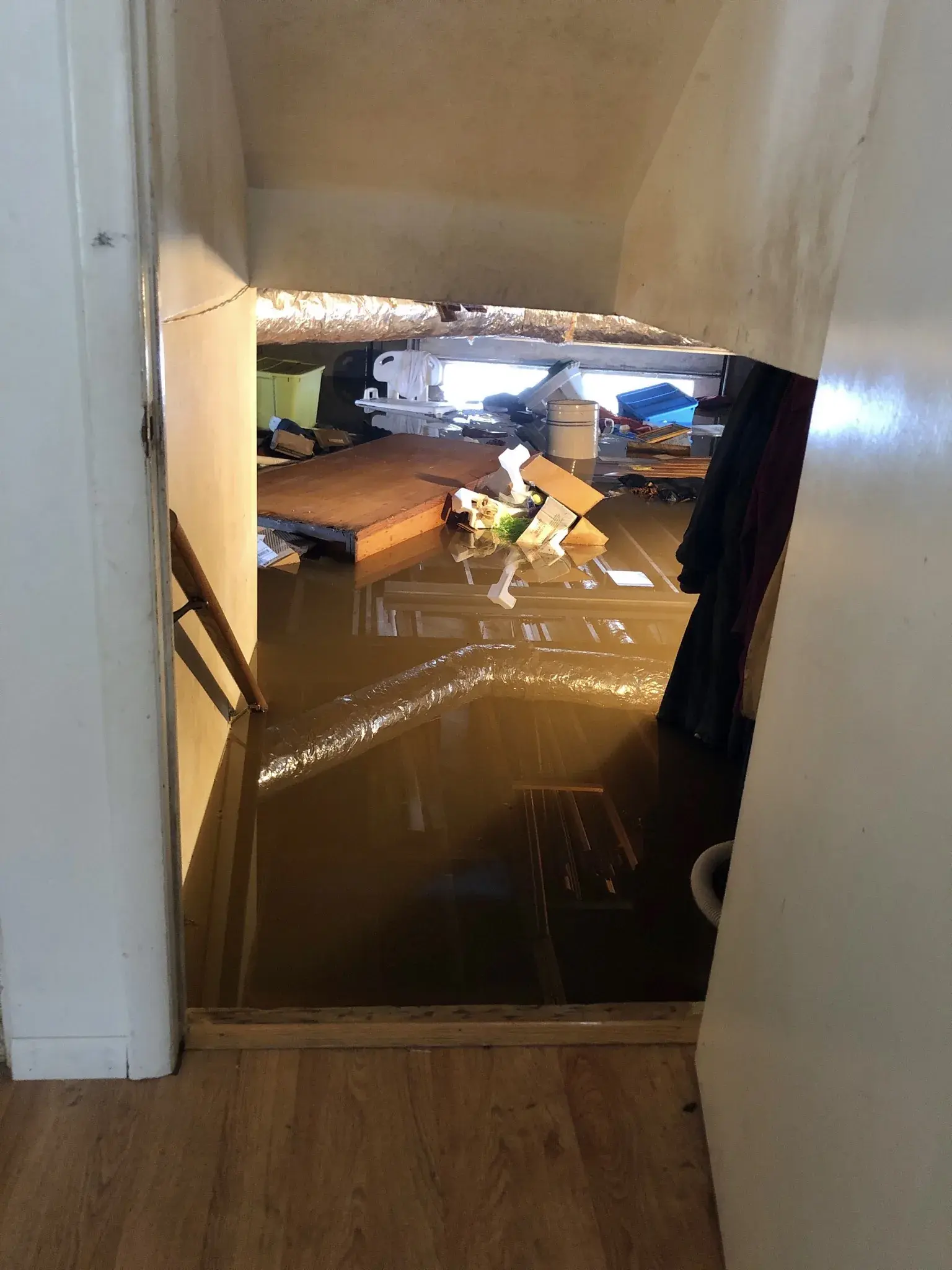
How water gets into a basement
- Surface seepage — water from roof downspouts or poor grading collects against the foundation and finds its way through the wall or the cove joint where wall meets floor.
- Hydrostatic pressure — saturated soil pushes water through cracks, block joints, and floor seams. This is the one that shows up after days of rain, not minutes.
- Sump pump failure — a pump that has lost power, seized, or been overwhelmed by volume. Power loss during a storm is the classic trigger.
- Weeping or drain tile problems — an older perimeter drain that is clogged with roots and silt stops moving water away.
- Sewer or floor drain backup — the lowest drain in the house becomes the relief point when the municipal system surcharges.
- Plumbing failures above — a supply line, water heater, or laundry connection upstairs that drains into the basement ceiling.
- Window wells and stairs — a well without a working drain fills and overflows through the window frame.
- Condensation — warm humid air meeting cool basement surfaces, which can mimic a leak without any water source at all.
Why below-grade drying takes longer
- Concrete and masonry hold water and release it slowly compared with drywall or wood framing.
- Soil outside the wall stays saturated after the rain, so moisture keeps migrating inward for days.
- Cooler air holds less moisture, and dehumidifiers have to work against a continuously damp source.
- Many basements have poor ventilation and limited airflow paths around stored contents.
- Stored items packed against walls block airflow to exactly the surfaces that need it most.
- Carpet and pad installed directly on a slab act as a sponge and are often not salvageable.
What to do immediately
- Do not walk into standing water in a basement if power to that area may still be energized. This is the single most important rule for below-grade water.
- Shut off the sump pump breaker or unplug the pump before touching it, then check whether the pump is blocked or has lost power rather than assuming it has failed.
- Move stored items off the floor and away from walls so air can reach the surfaces.
- Get wet cardboard, paper, and fabric out of the space — they hold moisture and feed mold.
- Start dehumidification as soon as the power situation is safe, and keep the space closed up rather than opening windows on a humid day.
- Photograph the water line on the wall, the affected contents, and the sump area before cleanup.
- Note whether the water is clear, muddy, or has an odor. Muddy or odorous water means contamination, which changes the cleanup method entirely.
If the water came up through a floor drain or a fixture, treat it as contaminated and stay out of it. Do not run a shop vac or household fan in a contaminated space.
What cleanup involves
- Water removal with pumps or extraction equipment suited to the space.
- Removal of carpet, pad, and any saturated porous materials rather than attempting to dry them.
- Extraction and drying of the slab and walls, with readings taken at the base of walls where moisture wicks upward.
- Drying the framing behind finished basement walls, which often means either cavity access or a specialty drying approach.
- Dehumidification with enough capacity for a cool, dense space — an undersized unit will run continuously and never catch up.
- Contents handling: hard items cleaned, porous items evaluated honestly.
- Addressing the cause: drainage, grading, sump capacity, or plumbing repair, depending on why the water arrived.
Reducing the chance it happens again
- Extend downspouts several feet from the foundation and keep gutters clear so roof water is not discharged against the wall.
- Check that the ground slopes away from the foundation rather than back toward it.
- Test the sump pump before storm season and consider a battery backup, since the outages that matter most are the ones that happen during the storm.
- Consider a water alarm on the basement floor; early warning turns a big cleanup into a small one.
- Keep storage on shelves or pallets rather than directly on the slab.
- Avoid installing carpet directly on a slab in a space that has ever taken on water.
- Ask a plumber about a backflow valve if your basement has fixtures or a floor drain connected to the sanitary sewer.
Basements in the Tulsa area
Tulsa's soil is a large part of why basements here behave the way they do. Much of the region sits on expansive clay that swells significantly when saturated and shrinks as it dries. That movement opens and closes cracks in foundation walls and floor slabs over the seasons, so a basement that stays dry through a wet spring can still seep during a long rainy stretch when the ground is fully charged.
The 2019 Arkansas River flooding demonstrated how quickly that changes. With Keystone Dam releasing high volumes for an extended period, low-lying areas west of downtown and in Sand Springs dealt with groundwater conditions that lasted far longer than a normal storm, and sump systems that had handled ordinary rain were not sized for it.
Below-grade space is less common in this market than in older cities, which means when it does exist it is often an older cellar, a converted garage, or a partial basement in mid-century housing. Those spaces were frequently finished decades ago with materials that do not tolerate water — carpet on slab, drywall to the floor, and particleboard cabinetry. When they get wet, the honest answer is often that the finishes come out.
Practical advice specific to this market: check the sump before spring storm season rather than during it, keep downspouts discharging well away from the foundation, and treat any recurring seep during heavy rain as a drainage question that a cleanup alone will not solve.
Questions about basement water damage
How long does it take to dry a wet basement?
Longer than a comparable area above grade, often five to seven days or more. Concrete and masonry release moisture slowly, the soil outside the wall stays saturated, and cool below-grade air holds less moisture. The job is finished when readings say so, not on a fixed schedule.
Can I dry out a wet basement myself?
A small seep with no carpet and nothing stored on the floor can sometimes be handled with a dehumidifier and a fan. Anything involving standing water, sewage, carpet on slab, or finished walls warrants professional help, and any standing water near electrical equipment means staying out until the power is confirmed off.
Does insurance cover basement water damage?
It depends on the cause, and the distinction matters. A burst pipe or failed water heater is commonly treated as accidental discharge and often covered. Seepage, groundwater, and rising water are typically excluded and require separate flood coverage. Talk to your insurer about how they classify your specific situation before you assume either way.
Why does my basement keep getting water every time it rains?
That pattern usually points to drainage rather than plumbing: saturated soil pushing water through the wall or cove joint, a failing perimeter drain, downspouts discharging next to the foundation, or ground sloping toward the house. Cleaning it up without addressing the source means you will be cleaning it up again.
Should I run a dehumidifier in the basement all the time?
In many Tulsa basements, running a dehumidifier during humid months is reasonable preventive maintenance, especially in a finished or conditioned space. Set it around 50 percent relative humidity rather than trying to reach desert-dry conditions, and keep it draining continuously so you are not emptying a bucket every day.
Need help with basement water damage?
Send a short request and we will use your details to connect you with available local providers.
A call option is being set up for this site. In the meantime, use the request form and we will follow up with available local providers.
- Independent information and connection service
- No cost to submit a request
- Available for Tulsa, Broken Arrow, Bixby, Jenks, Owasso, and Sand Springs
Tulsa Water Damage Help does not publish a phone number until a tracked line is configured, so no one reaches a dead number.
Service information and connection requests on this site may be provided through third-party service providers. We may receive compensation when a visitor connects with a provider.
Request help
Name, phone, ZIP, and what is happening. That is all we need to start.